

I still remember the dopamine rush when, just hours after sending my first LinkedIn pitch to a journalist, they replied: “I talked to my editor, and this sounds like it could be of interest to us.”
As a PR, my daily challenge is securing placements for clients’ thought-leadership content in tech publications. A few months into my role, I noticed that journalists don’t always check all emails from PRs, or answer their phones all the time. As my journalism course taught me, some journalists much prefer to be approached in different ways – through Telegram, WhatsApp, X or LinkedIn.
Combining my journalism course with basic human psychology, I wanted to test LinkedIn in a very focused way. After all, everyone’s daily lives are full of snappy, quick DMs across different channels.
Since my first LinkedIn pitching success, I refined my approach and these were the initial results: out of 59 LinkedIn messages, 22% resulted in coverage, 24% opened up a conversation or led to feedback, and 54% were ignored or never opened.
Compared to email, this is higher. According to media database Propel, journalists open about half (46%) of the story pitches they receive, and respond to around 3% of them. Humbly, I dare to suggest my LinkedIn results are solid results. Still, LinkedIn definitely isn’t the right channel for every journalist – or every situation. But if you’re starting to test it out for pitching purposes, here’s what I’ve learnt so far.
Before you hit send
First, you need to get the journalist to accept your connection request. In your introduction note, write a line about who you are and why you are connecting, with a particular emphasis on their beat.
After you add a journalist on LinkedIn, observe how they interact on the platform. Are they regularly online? Do they post often? What do they post about? A quick Google search might reveal public information on how they prefer to be pitched. If they only have a few connections, never post, and lack a profile picture, chances are you might be throwing spaghetti at the wall.
Once the journalist accepts your request, consider whether your pitch is truly relevant to them. The last thing you want is sending a pitch about your client winning an award to the BBC Tech Editor. Timing is equally crucial. Journalists covering fast-paced news cycles often file multiple stories per day and will only have a few hours to accept pitches. Others working on longer features may revisit your message months later (if you are tenacious enough to follow up).
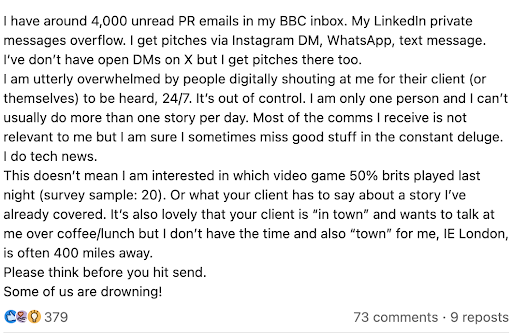
Zoe Kleinmann, BBC Technology Editor, on the pains of irrelevant pitches
Informal but make it smart
Compared to an email, LinkedIn messaging should feel more like an informal conversation. While it’s still important to double-check your spelling (yes, there is a journalist called Wiliam with one L), just make sure your message makes sense, and the tone can be more relaxed.
Start your message with one sentence saying you work in PR and represent a certain client. Then, avoid being someone who triggers the *sponsored message* trauma. TL;DR: keep it short, cut the jargon, hide ChatGPT traces. Nobody wants to read your tediously long message about how a leading solutions provider revolutionises the ever-evolving technology landscape. Not on a busy day. Definitely not on holiday. A good pitch doesn’t need to be packed with too many details, as long as it includes a compelling angle and explains why this matters now.
If your pitch does get a bit longer, try breaking it into bullet points so the chat looks digestible. If you’ve already sent an email pitch, mention it and include your full email address so the journalist can easily find it in their inbox. This makes it easier for them to connect the dots and follow up in the way that suits them best.
From DMs to coffee chats
A great thing about social media is that it allows you to build rapport over time. You can engage with journalists’ posts, which helps the algorithm prioritise their content in your feed. Many journalists post urgent PR requests, and interacting with them increases the chances it’ll reach you and they’ll read your pitch. After a few successful collaborations, you could invite them for a coffee to exchange notes, as they’ll likely be more open to it once they know you understand their beat.
Et voilà – here’s to your new LinkedIn friend!
